Teenage Engineering Ting FX EP-2350 microphone teardown

Stockholm-based design and electronics company Teenage Engineering has been making playful, minimalistic devices for nearly two decades, and their unique creations really stand out in the field. Drawn in by their fresh designs and engaging products, I recently tore down the Teenage Engineering EP-40. As a product design engineer, I had an absolute blast uncovering how the team designed the series of synthesizers to simplify assembly and allow for new “flavors” to be created with a handful of color and printing tweaks.
Naturally, the accompanying chunky little microphone, the EP-2350 Ting, seemed worthy of a teardown as well. Teenage Engineering mentions a hidden button, which was just asking me to take it apart. I was eager to see if the elegant and simplistic engineering of the EP-40 carried over to the EP-2350 microphone. Spoiler alert: It didn’t.
For starters, I was surprised to see that the two paired products were made in two different countries: the synth in Spain and the mic in Vietnam. And while the synth is full of clever, streamlined design choices, the mic is unnecessarily complex and lacks that same engineering elegance. With the stark differences in under-the-hood design, I have to wonder if they were created by two different teams.
Don’t get me wrong: It’s a great little mic from a user perspective, but just not so much from an engineering and manufacturing perspective. Nonetheless, it did have some neat features.
If you’re interested in a video overview, look no further:
A sweet surprise

When inspecting the circuit board, a certain logo stood out to me immediately! It seems the EP-2350 is powered by none other than a Raspberry Pi 2350. (RP2350A0A2, if you wanna get specific). This is a first for me, as I typically associate Raspberry Pi with low-cost Linux computers used mainly for prototyping or industrial projects, not consumer electronics. The 2350 is a powerful little microcontroller which gives the Ting microphone it’s quirky abilities and naming convention.
Yes, this microphone can be used as a simple mic. But it can also add effects to the audio based on input from an onboard accelerometer and the position of the lever, letting you get pretty crazy. Furthermore, you can adjust how the microphone behaves using the aforementioned web app, all thanks to this Raspberry Pi.
Lever overload

The lever that’s used to turn on and off the microphone has a lot more going on than I initially expected. Mechanically, it has four components including the lever itself (1), a machined metal hub (2), a torsion spring (3), and a molded plastic spacer (4). Electrically, it has three ways of sensing the position of the lever. One switch (5) detects when the lever is depressed at all. Another switch (6) is triggered when the lever is fully depressed. The pivot point of the lever is actually a potentiometer (7), which is a fancy way of saying it senses rotation.
I think we’ve found our “secret button”! It’s triggered when you press the lever all the way down. I think the other button is used to actually wake up the microcontroller here, and it’ll enter sleep mode after a few minutes of inactivity. The rotation sensor is used for fun — you can map the intensity of sound effects to the lever position. Wild and complicated!
Props, though, for the cool-shaped circuit boards! They’re a sign of a tight collaboration between engineering and design teams.
Seeing the light
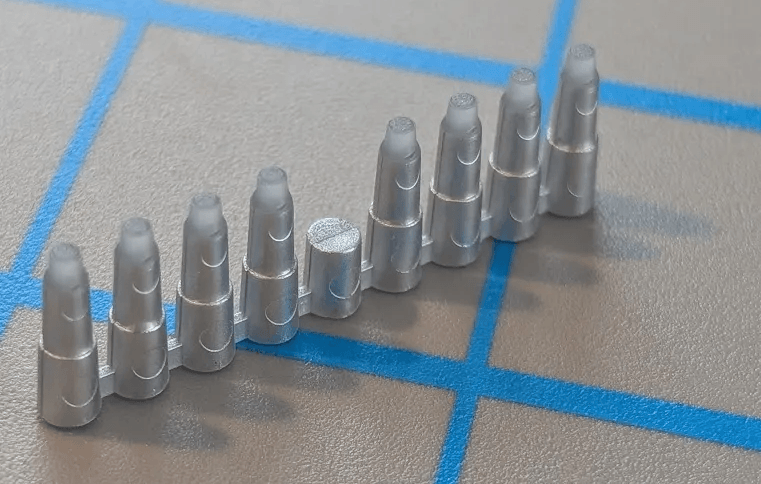
The light pipe is a fancy little guy! Its comprised of eight bullet-shaped plastic bits that are all connected by a single sprue of plastic to hold them all together. The tips are textured to help diffuse light. The plastic is molded milky white to help with light transmission and diffusion, too. Lastly, this part is then masked off and painted silver to reflect light inside and prevent it from bleeding to its neighbors. Overkill? Maybe. Cool? Yes.
Mic check, one two
In my full teardown, I include a bill of materials for the mic, and there are 24 parts. Though 24 distinct parts seems high, I think this is a deceptively complex product. It’s also doing far more than a standard-issue microphone. However, as I mentioned earlier, it’s lacking the engineering elegance I highlighted during the EP-40 teardown. Still, it was fun to tear down and take a peek inside. If you want to get down in the weeds with me and look closer at the electronics and housing, check out the full teardown.
Informal is a freelance collective for the most talented independent professionals in hardware and hardtech. Whether you’re looking for a single contractor, a full-time employee, or an entire team of professionals to work on everything from product development to go-to-market, informal has the perfect collection of people for the job.