Braille color printer enhances scientific discovery for blind people
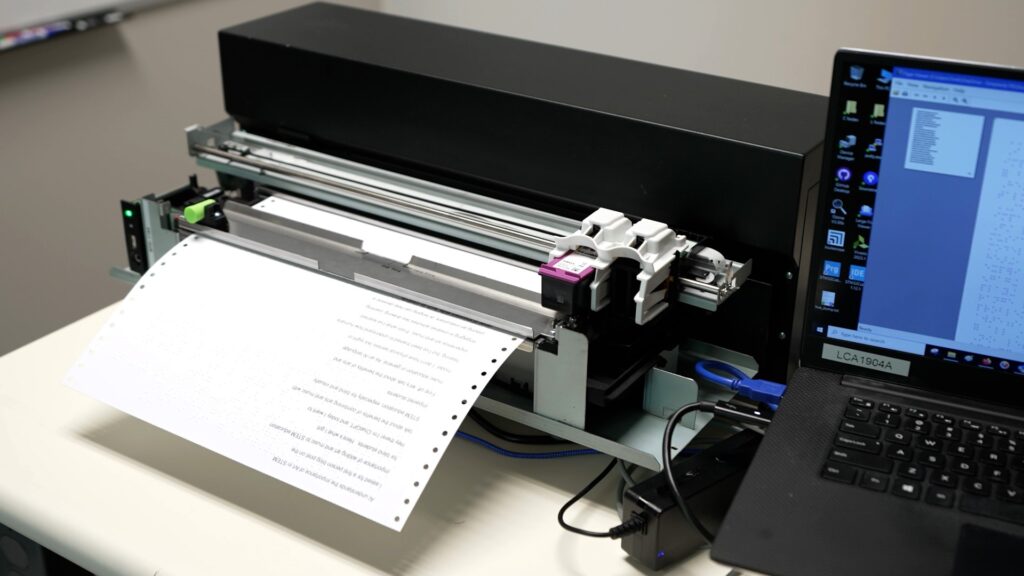
Why would a blind person need to “see” color? If you consider how many charts, graphs, and diagrams there are in scientific and STEM applications, then it’s clear that students and professionals in these fields who are visually impaired could truly benefit from innovations that allow them to access this data like everyone else.
For over two decades, ViewPlus has been developing innovative braille and tactile graphics hardware and software solutions. The company was founded by Dr. John Gardner, a physics professor who had an eye surgery that left him blind. A researcher at heart, he sought another way to access the information he was able to previously. ViewPlus’ inclusive, accessible, and affordable products are designed to assist visually impaired people in their studies and careers by enabling them to feel colors, charts, and graphics that in the past were only available to sighted individuals. ViewPlus’ innovative products especially improve the learning environments of visually impaired students and their teachers in the STEM community.
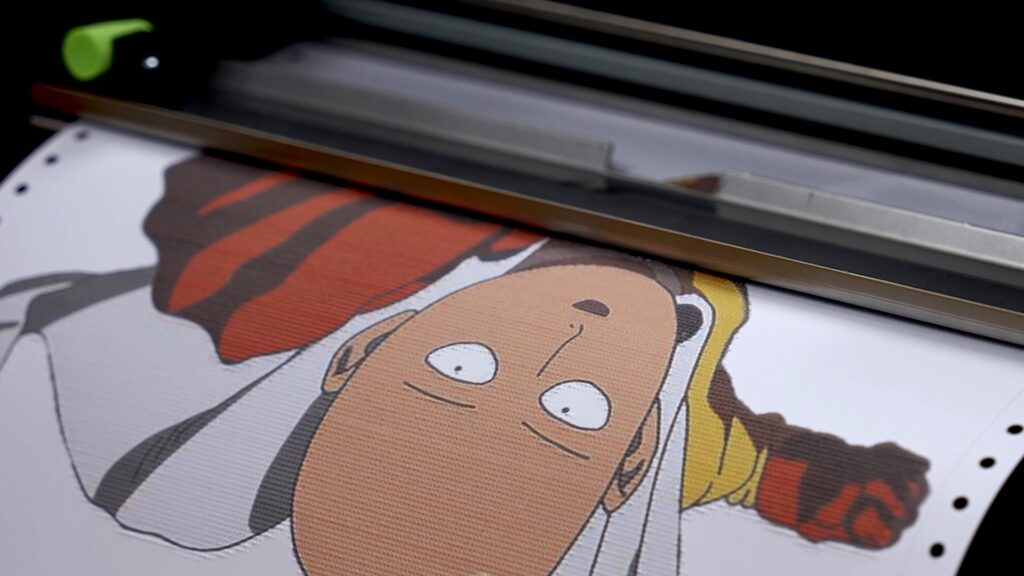
ViewPlus came to us at Simplexity Product Development to help develop their latest product, the Color InkConnect. This groundbreaking product combines fast, high-quality HP inkjet printing technology with braille and tactile graphics. The overlay of printed color pictures and images onto embossed braille allows both a blind and seeing person to access the same data simultaneously. This revolutionary technology has improved the ability of blind and visually impaired people to work, learn, and maintain independence.
The challenge
The objective of the project was to create a new custom product that would meet the following criteria:
- Seamlessly integrate with the previous ViewPlus embossers
- Be manufacturable at low and high volumes
- Optimize the use of custom and off-the-shelf (OTS) parts to minimize product complexity and cost
- Match the output paper path of current embossers
- Be cost-competitive to ensure marketability
- Provide the client with a successful transition plan to higher production
- Support a large variety of print modes, such as dual pass printing
The solution
Simplexity designed a custom printer that encompassed high-end printer technology (leveraged from HP printers with the support of the HP SPTS team) and custom parts to allow for more advanced braille printer technology.
This system can integrate with multiple embossers by using a custom adaptor piece that can be quickly and easily changed out between each embosser. This allows the end user to update or upgrade embossers without requiring a new printer system.
The new design uses a combination of custom and OTS parts to reduce cost and decrease repair time for any units in use, minimizing the unit’s down time. For all custom parts, the pieces were designed for low and high-volume production, which reduces continued tooling investments as production increases.
The new system matches the output paper path of current embossers and sits directly in front of or behind the embosser (depending on which embosser is in use).
During development, Simplexity made design decisions to create an easy transfer of the design back to ViewPlus for manufacturing, including:
- Manufacturing at ViewPlus-approved locations
- Quoting multiple vendors and recommending new manufacturers based on quality, history, and cost
- Creating custom build, test, and inspection documentation that could easily be transferred to the ViewPlus team or any contract manufacturer
- Creating new tooling and processes to aid in assembly, creating use and maintenance. documentation, and validating the process with qualitative results.
The process
Simplexity first completed a Phase 0 Investigation to confirm the feasibility, initial estimates of scope, cost, and duration, and some defined risks. Moving into Phase 1-2A and Phase 2B, Simplexity completed the fully customized system to meet the requirements as defined with the client.
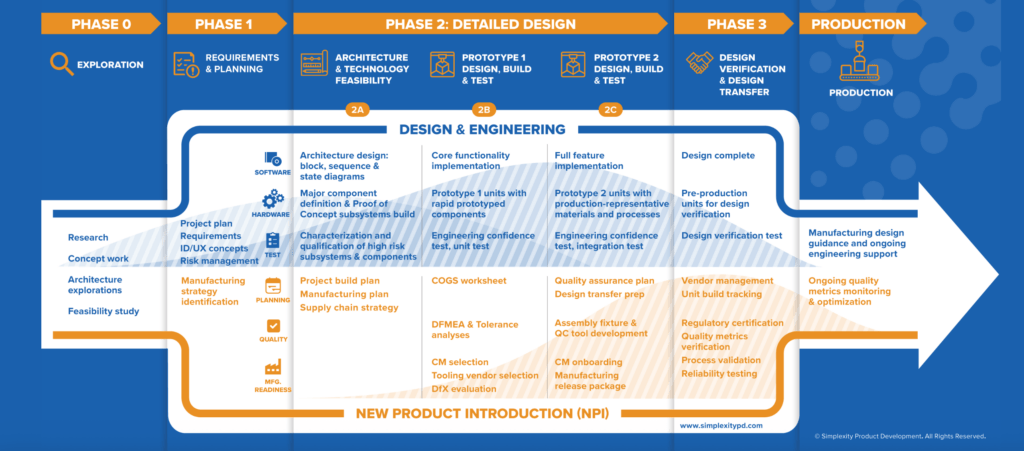
Simplexity’s full development included complete mechanical design, electrical design of custom PCAs and cables, and firmware and software design to implement the new behaviors and functionality. Multiple risks were identified, and mitigation plans were completed to ensure the product was viable and producible.
The final design contained not only the Simplexity design team’s input but also underwent extensive client design reviews, submittals, and approvals prior to transitioning into prototype build and test. To evaluate the new system, Simplexity completed a custom test plan, mapping each test back to the developed requirements. All attributes and functions were fully tested prior to delivery.
To ensure a clean and consistent build after design transfer back to ViewPlus, Simplexity developed custom tooling and fully documented processes for assembly and testing that can be maintained by ViewPlus or any contract manufacturer.
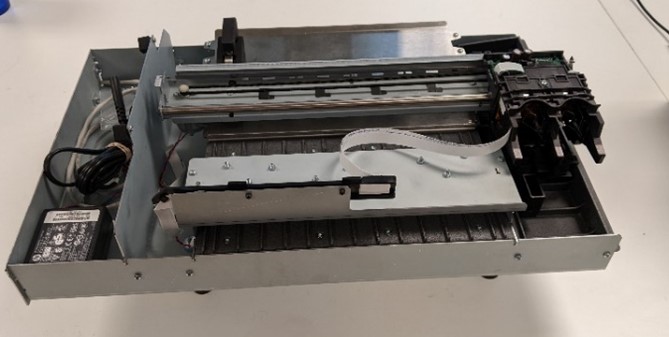 |
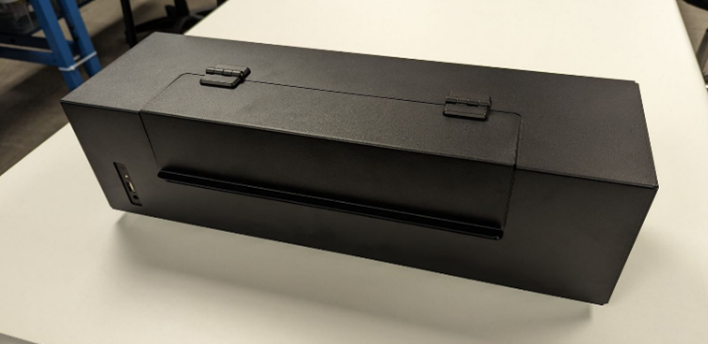 |
| Initial Proof of Concept Unit (Phase 1-2A) | Final Prototype (Phase 2B) |
The following five sections highlight actions our team took in the realms of:
- Firmware engineering
- Mechanical engineering
- Electrical engineering
- Project management
- General product design
Firmware engineering
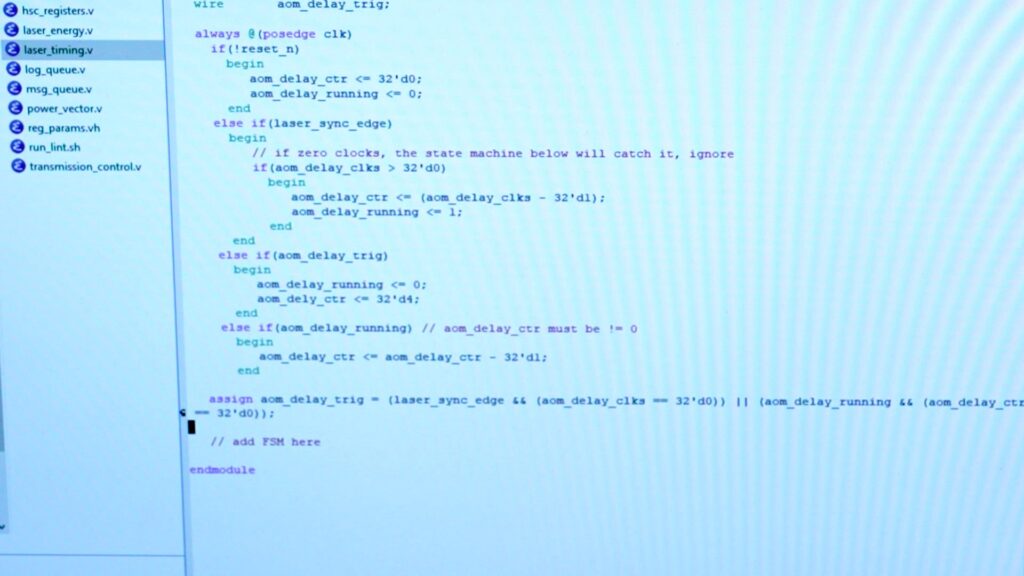
- Created custom firmware to implement communication via ethernet as well as USB between the printer and embosser/computer
- Created firmware to control all motors, encoders, and physical behavior of the printer system
- Implemented printing quality of 600 dpi and increased client capability to print a full-size page in less than 28 seconds
- Enabled firmware updates via the USB port while protecting the unit security by removing any backdoor features
- Implemented three print modes: draft single pass printing at 300×300 dpi, normal single pass printing at 600×600 dpi, and best dual pass printing with overlap masking
- Implemented firmware controls based on all the sensors installed, including missing paper, paper jams, ink status, and multiple job processing
- Implemented new audio capabilities to allow visually impaired individuals to troubleshoot the system
Mechanical engineering
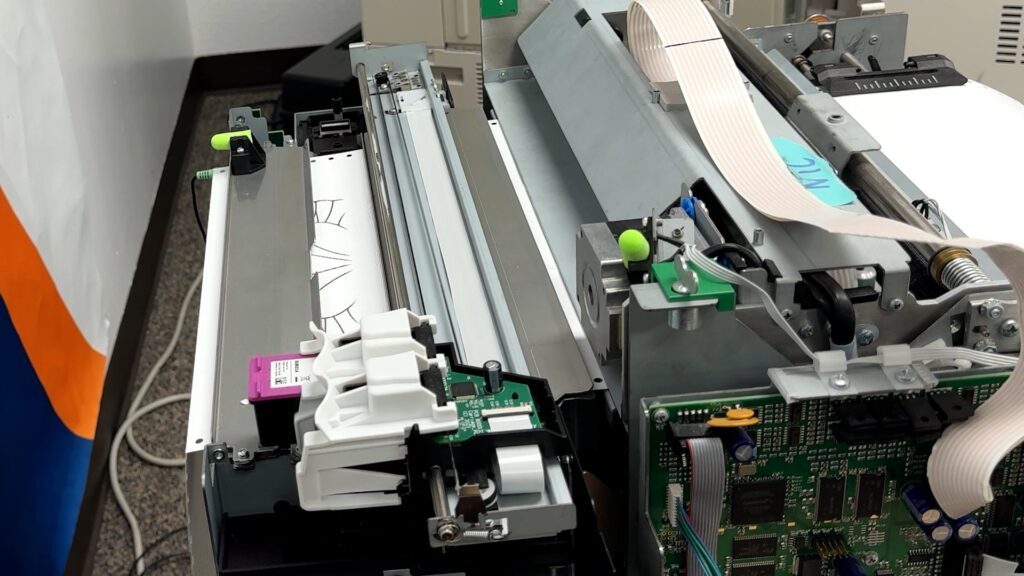
- Extended the width of a standard HP printer to match the width of the embossers
- Designed custom parts that were manufactured by the client’s suppliers to allow for easy design transfer
- Leveraged as many parts as possible from high-end printer technology including HP SPTS parts that could be purchased directly in large quantities
- Implemented visual indicators (LEDs) as well as audio capabilities to ensure the unit could be operated by sighted individuals as well as visually impaired individuals
- Designed a cover that allows all basic maintenance to be done through that one easily accessible area
- Implemented sensors to ensure end user safety, printer protections, and easy troubleshooting, including paper jams, ink levels, and paper alignment
- Created custom cables to allow for custom routing, preventing cable crimps, and preventing cable damage during maintenance functions
- Designed final user Interface for multiple audio jack cable connections to prevent any user issues based on cable availability
Electrical engineering
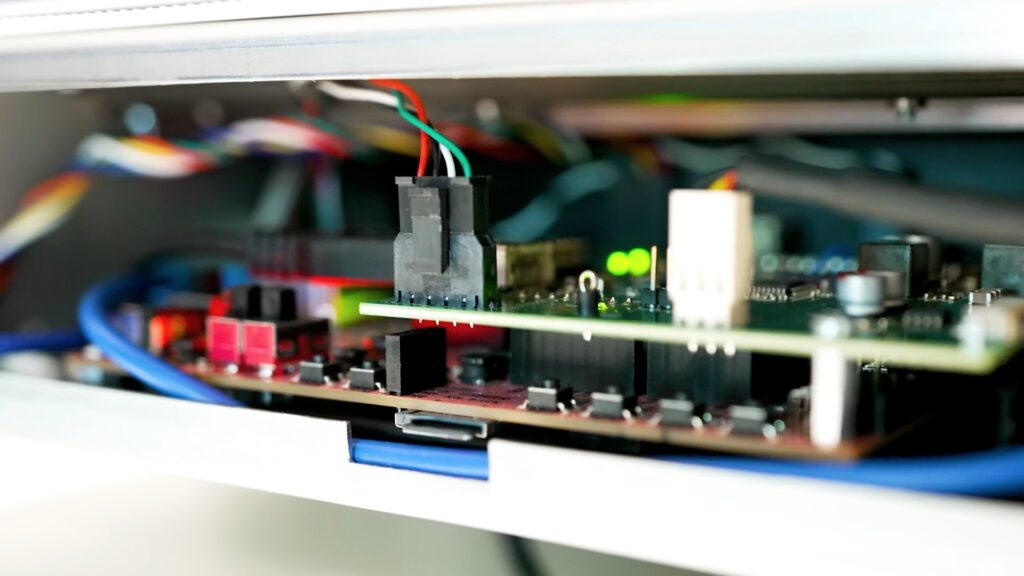
- Used standard off-the-shelf (OTS) boards when possible, reducing initial development investment and ensuring lower production costs
- Developed four custom PCAs to address user interface electronics, wiper station motor function, carriage motor function, and a daughter board to the OTS board to increase functionality and customize the interface
- Incorporated OTS cables and created two custom cables to allow for easy assembly, customized signal routing, and additional electrical properties needed for signal transmission
- Developed each board with a custom bring-up test approach and checklist that was then transferred to ViewPlus to aid continued production
- Captured and updated all board manufacturing documentation including schematics, layouts, block diagrams, and routing information based on feedback from the PCA manufacturers
Project management
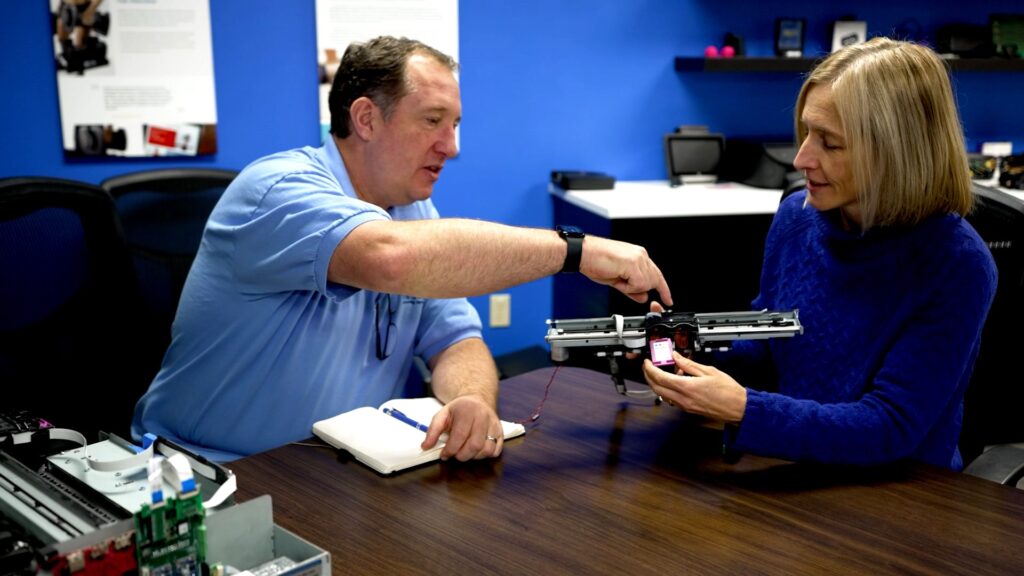
- Provided budget, schedule, and progress reports to ViewPlus
- Confirmed that test procedures and results met product requirements
- Coordinated tasks for all the team members to meet the client objectives
- Scheduled and held meetings, took notes, assigned action items, and followed up on progress
- Ensured that the project was completed on time and under budget
General product design
- Designed the system with recurring cost and end-user sale price in mind
- Quoted parts from multiple sources when possible, including suppliers already in use by the client
- Evaluated molds and custom tools for long term production and cost impact prior to deciding on a manufacturing process
- Designed the structure of the unit to optimize for how it may be carried, and identified potential damage paths for the product prior to creating the final prototype
- Provided input and fit results when evaluating the system for packaging designs
The results
The result of this engineering effort is a product that fully integrates with the ViewPlus embossers and increases the functionality of the print/emboss combination. This printer system allows for greater independence for visually impaired individuals while increasing the learning tools available in STEM fields.
By implementing LED and sound capabilities, this system can be operated by seeing and non-seeing personnel, making maintenance and updates easier for everyone.
This design has been created with future capabilities in mind, including adding extra internal USB ports, leaving space on boards for future electronics, and allowing firmware updates to be made via an external interface. This allows ViewPlus to continue to grow the system with additional functionality with little or no impact on the overall design.
This product also allows for development of greater creative content for visually impaired individuals including games, puzzles, and other activities that were previously unavailable. This additional content and functionality continues to close the gap between the visually impaired and non-visually impaired individuals and will allow for more opportunities to learn, problem solve, and create!
Editor’s note: This article first appeared on the Simplexity site. Our friends at Simplexity shared it with us, and we applaud their efforts to make this groundbreaking and accessible product. They also hosted the first San Diego Hardware Meetup and have supported Hardware Meetups in San Diego and Seattle.