What is a collective anyway?

If I had a dollar for every time Sam and I get asked what a collective is, we could write small angel checks for early-stage hardware founders. As a follow up, we also often get asked “Are you guys just a bunch of hippies?” or “Do you sit around in a drum circle smoking pot?” While I can neither confirm nor deny the latter, we’re definitely not a bunch of hippies (see our recent blog post about punk rock). To ensure we have a better answer than an eye roll the next time these questions come up, we thought it would be helpful to spell out what exactly a collective is, why we call ourselves that, and why we think this model of working and building companies is the way of the future.

Collectives have a rich history in the art world
Our use of the term “collective” comes from art collectives like Fluxus in 60s and the Dada movement before them. These were networks of artists who came together to work, play, and disrupt the status quo of the art world. They presented an alternative vision for how to produce creative work, inspiring much of the tech art community we all know and love today at places like ITP at NYU, MIT Media Lab and the CMU CREATE Lab. These were radical thinkers who reimagined work and community during times of profound technological and societal changes, times not too dissimilar from today. Today we’re also faced with the rise of technology and policy that are reshaping society: geopolitical tension is straining relations between economies, social media has made it harder to find community in the real world, and AI is coming for all our jobs.
“A collective is a community of people who work together to achieve some outcome.”
Like in the early 20th century after WW1, as well as after WW2 and Vietnam, one solution to these rapid changes is to focus on building more community, more cooperation, and more infrastructure for the productive collision of ideas, talent, and capital. That’s what a collective is: a community of people who work together to achieve an outcome. Collectives are also sometimes called communities of practice. In particular, collectives entail familiarity between members as collaborators not just participants, as well as shared resources and methodologies to ensure cohesion and effectiveness. That’s the big difference between a collective and a talent market place (another example of a community of practice), where members generally don’t know or interact with each other.

Collectives are communities where members work together
Because collectives are tight-knit communities that work together, they might also be confused with traditional agencies and consultancies that also have tight-knit communities of full-time employees. But collectives aren’t agencies because collectives don’t have employees. The members of a collective are all voluntary and usually have their own clients or jobs outside of the collective. They join for work opportunities and to meet clients that fit with their schedule outside of the collective, but also to connect with and be surrounded by peers who generally number in the hundreds to thousands (versus agencies that cap out at tens to hundreds, which is a lot of salaried employees).
“The classic employer/employee relationship is broken.”
So why did Sam and I decide to start a collective and not an old fashioned agency? It boils down to this: We think the classic employer/employee relationship is broken. We want to live in a world where workers have autonomy over their labor and companies have more agile workforces. This is particularly applicable to hardware, where the product development cycle has tons of downtime baked in, whether waiting for parts or a parallel engineering work stream to catch up. During those down times, an exceptionally talented salaried engineer is burning a big hole in the company’s budget. And chances are they’re bored as hell. That was Sam’s experience at his last salaried job before we started informal. He’s exceedingly fast at what he does, so in the months between handing off his parts designs and receiving physical parts in hand, he’d have nothing to do but play ping-pong (which he got really, really good at).

No company wants their high-priced engineer becoming a high-priced ping-pong player, no matter how much VC money they have to burn. All companies, particularly hardware companies, need the flexibility to ramp up talent when they need it, and ramp it back down when they don’t. This happens already, but in a much more brutal way with hiring bursts followed by layoffs when the work slows down. That’s bad for everyone: the employers who get a bad reputation, the talent who need to find a new job, and for the ecosystem overall.

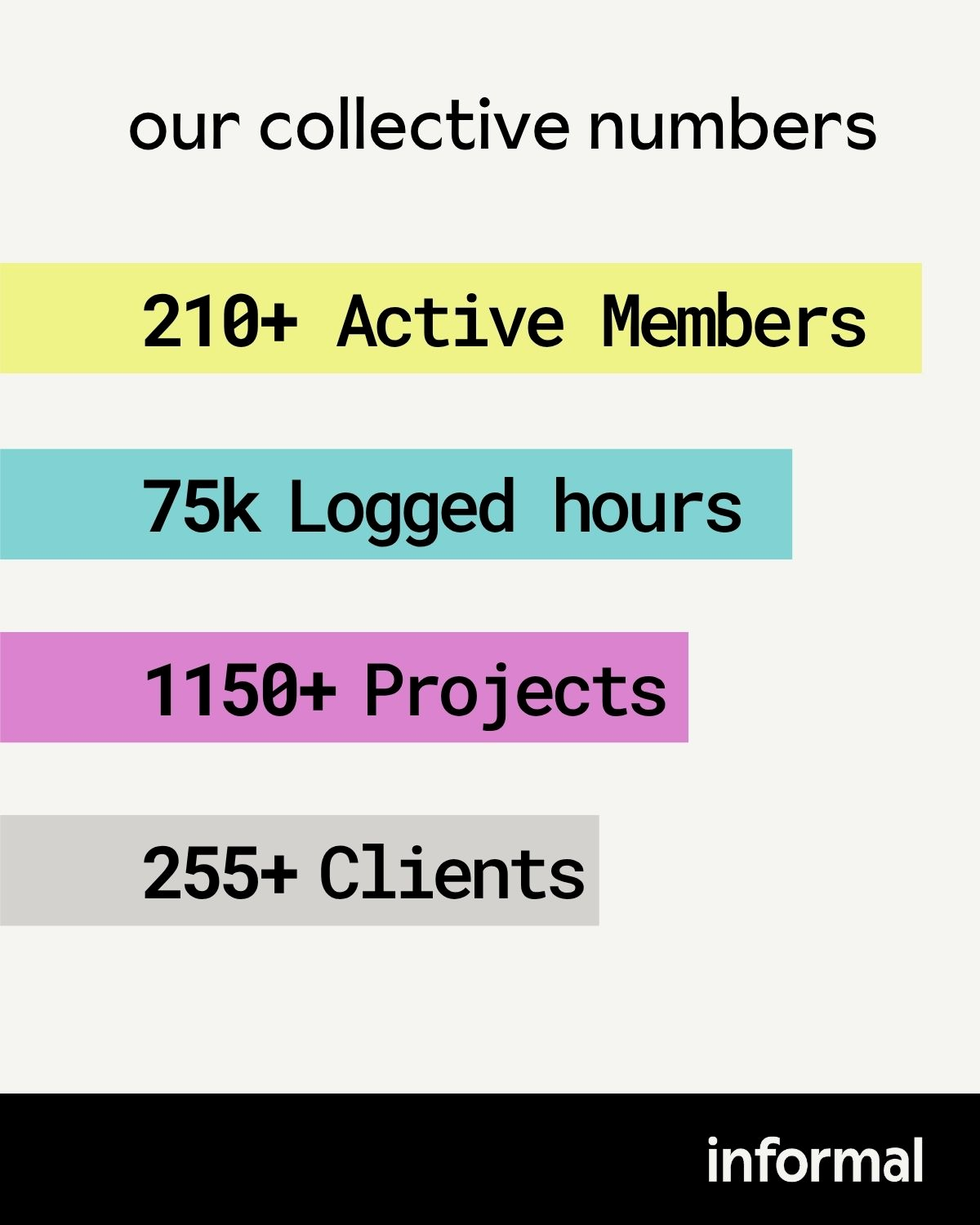
We spent the past six years building the community and the infrastructure to support collective action for clients. The results have been incredible for everyone involved: 80% of our members have worked on an informal project, and the remaining 20% either just joined or their schedule hasn’t aligned with available projects yet. We’ve helped clients save over $50 million in labor costs and move 5x faster than they thought possible. That’s the beauty of the kind of just-in-time talent you get from a collective: you’re working with a community of highly skilled professionals who are ready to work when you need them, and have other projects to work on when you don’t.
If you want to experience the collective for yourself, fill out our contact form. If you’ll be at CES in January, we’d love to meet in person at our celebration of all things hardware on Tuesday, January 6. Tons of informal members and clients will be there. RSVP here!
informal is a freelance collective for the most talented independent professionals in hardware and hardtech. Whether you’re looking for a single contractor, a full-time employee, or an entire team of professionals to work on everything from product development to go-to-market, informal has the perfect collection of people for the job.