Industrial design 101

In the world of hardware development, most of the roles are fairly self-explanatory. A mechanical engineer works on the mechanical parts and an electrical engineer works on the electronics. Post pandemic, we probably all know what a supply chain manager does, too. The role that seems to be the most confusing to folks is industrial design.
I tend to write articles when I find that I’m constantly explaining the same concepts to folks, so here we are! Let’s learn more about the roles and responsibilities of an industrial designer in the hardware development world, how and when to use them, and how it can go wrong.
The who/what/why of ID
Industrial designers are responsible for the user experience on hardware. This can span the gamut from the form of the device, where buttons are positioned, the look and feel, and even the packaging and unboxing experience. Their job is to make the product desirable, intuitive, and enjoyable.
I frequently get requests for an “industrial engineer,” which is incorrect. An industrial engineer is responsible for laying out complex manufacturing processes for things like chemical formulation.
I like to think of industrial design and mechanical engineering as part of a long spectrum:
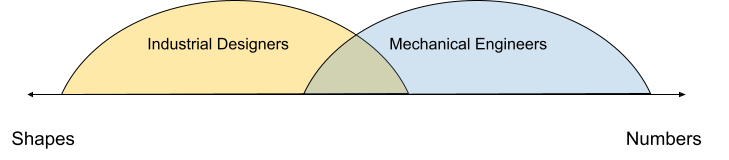
Industrial designers typically come from art and design colleges like RISD or Pratt, while mechanical engineers come from engineering schools like MIT or Stanford. As a side note, I’m very wary when someone claims to be able to do both industrial design and mechanical engineering well. Both require years of experience to develop the proper skills, and more often than not, they’re much better at one or the other discipline.
A good industrial designer understands the concepts of manufacturing, assembly, and budgeting, but has a super strong eye for what looks and feels good. Many can make excellent-looking shapes, but fewer also understand the complexities of what can be mass manufactured at a reasonable cost.
A good mechanical engineer appreciates the role of the industrial designer and works with them to ensure parts can be manufacturable. Many can make manufacturable parts, but fewer understand why a part needs to be more complex in order to accomplish a certain form.
A good team consists of both roles communicating well with each other and respecting each other’s contributions to the product. I’ve been part of projects where this is true, and other projects where they treat each other like enemies and the project suffers because of it. I think this is the most important dynamic to nail down on a project.
How not to work with industrial designers
There are two common scenarios I see during the hardware development process that highlight the incorrect ways to work with industrial designers.
Bad method #1: Industrial design to engineering handoff

“Make this work!”
The first bad method is to work with an industrial designer or firm first to determine the product form, materials, and features. When this phase is complete, they shop around the design to engineers to understand the costs to make it. Without fail, there will be issues in the product design that need to change to accommodate the realities of manufacturing or engineering. Batteries take up space, parts need to be easy to mass produce and assemble, and certain materials aren’t really used often (unless you have billions of dollars to spend like a certain fruit company). If you start with industrial design as step one of your process, you’re driving up the cost and complexity of the product.
Bad method #2: Engineering to industrial design handoff

“Make this look good!”
The second bad method is to flip this around and hand off a working prototype to a designer and say “make this look pretty.” Engineers are great at designing the most efficient method to solve a problem, but aren’t always great at making something an untrained user can operate easily. In this workflow, the industrial designer is hamstrung and typically limited to tuning up an existing enclosure without making meaningful changes to the product design. The result here is a clunkier product or user experience that doesn’t sell well.
Both of these processes treat design and engineering as sequential phases of the process, while in reality they should be in parallel.
How to work with industrial designers
The best method I’ve found over the last 15 years is to treat engineering and design as part of a parallel process rather than sequential.
Best method: Engineering and industrial design together

“Work together!”
Product design is an iterative process and requires input from all folks (I refuse to use the word “stakeholders”). Industrial designers should be free to create concepts and iterate, but seek input from clients and engineers throughout this process. Engineers should help assess part breakups, manufacturing methods, and material selections. The client should balance the tradeoffs of more expensive methods that yield better designs.
Working collaboratively ensures that the parts are both beautiful and manufacturable, reducing the time to design the product and the overall costs. Later, when the hardcore engineering process begins, the industrial designer should remain on the project to review any changes that may need to happen. A well-intentioned mechanical engineer may apply a tangent fillet instead of a curvature-continuous one accidentally, changing how the product looks without even knowing it. As my 2.5-year-old likes to remind his Paw Patrol action figures, “We have to work together, as a team!”
Here are a few things I’ve learned over the years about industrial designers and the process that may help when working with them.
Industrial designers are a gas
If you haven’t watched the show Silicon Valley, you should. They perfectly captured the dynamic between a stereotypical designer and engineer. Industrial designers are supposed to challenge what can be done and to ensure the product experience is as good as possible. However, that can lead to explorations into materials or manufacturing methods that are unrealistic for the product. A client, unaware of the repercussions here, will almost always choose the most complex design to engineer and will cause heartache later.
Because of this, I like to describe an industrial designer as a gas: They’ll take up the space you give them. Part of the scoping process is to help constrain them by defining the limits they can expand to without compromising on the design. This can be done by limiting the material selections, forms, manufacturing methods they should explore, or number of concepts to create during the process.

I like to describe a good engineer as a liquid — grounded but able to flow around obstacles. A bad engineer is a solid — unmoving and stubborn. Don’t be a solid. (I’m not sure if there’s a plasma equivalent in this analogy, but if there is, let me know!)
The inverted triangle
During the initial industrial design process, it’s common to share many high-level concepts before reviewing and narrowing them during a few rounds of refinement, resulting in a final design. I describe this as an inverted triangle:
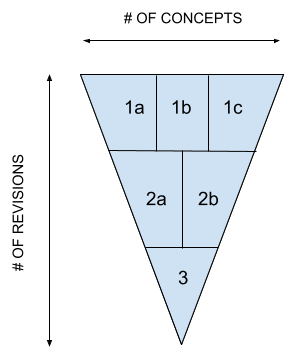
The triangle is shaped by the number of concepts and the number of revisions. You can adjust the shape of the triangle, but the area is essentially the cost you pay. Many concepts and few revisions may cost the same as a few concepts but many revisions.
If you’re tight on budget, the best things you can do here are provide an inspirational document to your industrial designer and be clear and opinionated about what you like or dislike. Show them products, brands, or even materials and textures you like. Limit your number of revisions within reason. Constrain the gas!
Here at informal, we have dozens of amazing industrial designers ready to roll. Some focus on furniture, others on human factors, and some prefer gadgets and gizmos. Reach out if you want introductions and to see how this process plays out in real life.
informal is a freelance collective for the most talented independent professionals in hardware and hardtech. Whether you’re looking for a single contractor, a full-time employee, or an entire team of professionals to work on everything from product development to go-to-market, informal has the perfect collection of people for the job.