Product development pitfalls: 3D printing overuse
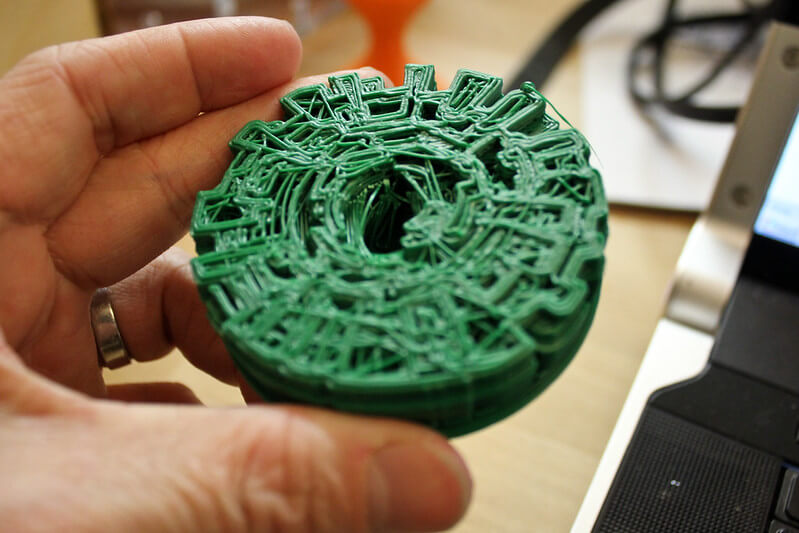
Photo by Marius Watz
Ever feel that 3D printing is creating more problems than it’s solving? I’ve been designing, engineering, and manufacturing physical products my entire career. I’ve worked in nearly every industry, from medical devices and aerospace to consumer products and automotive interiors. And in that 25+ year span, I’ve seen the knowledge and the tools of the trade get better, more accessible, and cheaper. But the most significant change has been a process shift in product development and how products come to life.
With a new generation of young entrepreneurs and engineers now learning the language of MVPs, design thinking, fail-fast, prototype & iterate, and so on, I’ve witnessed some pretty big issues when managing this new generation of talented makers and creators beyond the initial innovation or discovery. My colleagues and I have discussed how this continues to limit their abilities as product engineers and slows things down in our businesses. We’ve been talking about a sort of ADHD-level of focus, or lack thereof, in their core engineering skills. I never thought to write about it until I came under this spell myself — one created by the easy access to 3D printers both at work and now at home.
Undeniably, 3D printing has revolutionized the world of product development, design, engineering, and manufacturing. Its ability to create complex geometric shapes, reduce part count, aid rapid prototyping, and customize objects has opened new doors in many industries. However, overreliance on 3D printing also brings its own set of challenges and drawbacks when it comes to the quality of the end product or design. Recently, I met a start-up CEO who mentioned the garbage cans around his office full of failed 3D prints — not because the concept was invalidated, but because the part couldn’t even be used (due to factors like fit and strength).
Let’s explore some of the potential pitfalls of using too much 3D printing in a product development team, starting with the current limits of the technology.
Trap #1: Technology and process limits
Material limitations: While 3D printing technology advances, it still has significant material limitations. The range of materials available for 3D printing may not always match the mechanical properties needed for a finished product regardless of what the label (or the YouTuber) says. Many of these materials might lack durability, temperature resistance, or other key features essential for specific applications because they’re designed for stable printing.
And even as new filaments and resins hit the market, the designer must realize that a grade of plastic formed via extrusion pales in comparison to the same produced via injection molding or blow molding, or one of the two dozen other methods of forming plastic and composite parts from decades-long and proven manufacturing processes and equipment. The strength varies in the X,Y, and Z directions depending on the printing technology chosen (for example, SLS versus FDM).
Scale and efficiency issues: 3D printing can be ideal for prototyping and small-batch production but falls short in large-scale manufacturing. Traditional manufacturing methods are generally faster and more cost effective for even small volumes, and a heavy reliance on 3D printing may lead to inefficiencies in the production line or, worse, the need for a redesign when there’s a part deviation between what was used for a small batch run versus a traditional large-scale process.
Quality control concerns: 3D printed parts can sometimes suffer from inconsistencies, with variations in density, strength, and appearance between different prints. This can lead to challenges in quality control, potentially resulting in substandard testing. At the end of the day, it’s not an apples-to-apples comparison, and the engineers and designers may be redesigning a part that doesn’t need to be redesigned.
Environmental impact: 3D printing is often considered less wasteful due to its additive manufacturing process, but it still has an environmental footprint. Energy consumption, emissions from materials processing, and the waste of unused materials can contribute to adverse environmental impacts — especially when the parts end up in the trash bin because they couldn’t work. There’s also less reliability in 3D printing the faster you go, increasing scrap rates (failures per batch of parts made).
High costs for specific applications: For certain applications, the costs associated with 3D printing, including machinery, materials, and maintenance, can be prohibitive. These costs may outweigh the benefits for some projects, making traditional manufacturing methods more suitable. For example, a design that screams sheet metal is forced into 3D metal printing and, in the end, costs the customer 16 times more per part than if they waited three to four weeks for tooled sheet metal samples.
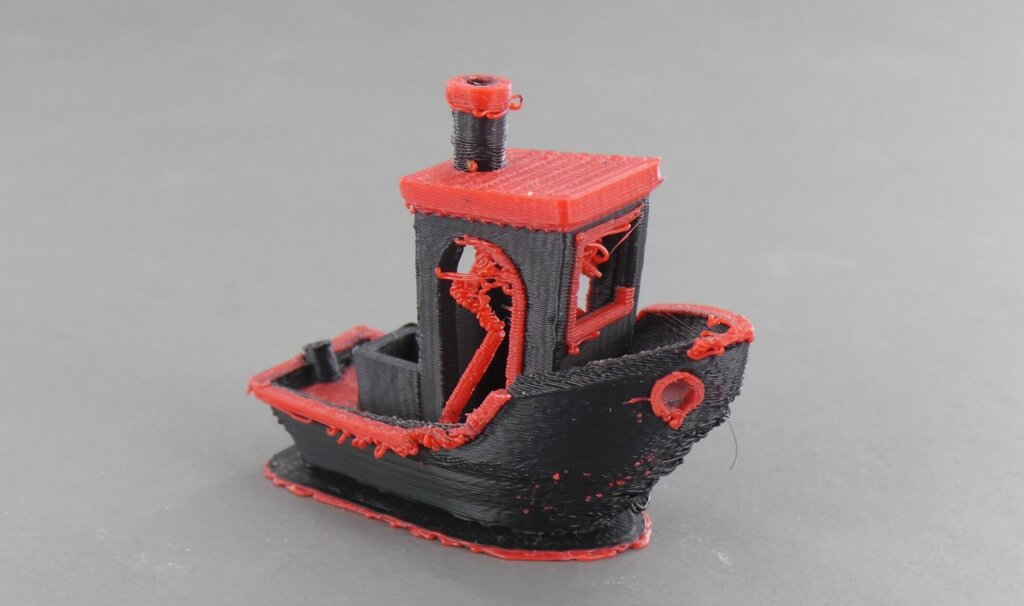
Photo by 3DBenchy
Trap #2: Modern day 3D printing overemphasis = underemphasis
Let me be clear: I’m not anti-3D printing or trying to downgrade its value. I love 3D printing! I own several printers and use them regularly. I even did R&D work in the early days of 3D printing as a grad student in the late 1990s. But I’ve noticed how quickly I, too, have strayed into the bad habits I’ve seen young engineers fall into.
I’m also talking about all the well-rounded skills needed to transform a great idea into a reliable product. As just one example, I’ve met more senior-level “design” engineers who hadn’t done a single detailed 2D drawing, GD&T, FEA, CFD analysis, or a number of other must-have skills needed when I was starting out.
Back then, if you were into product design, you knew these skills within your first year at work. Today, their default answer is to print it rather than spend 15 minutes doing a simple math problem to determine the strength of an object. In the past, when a new tool was introduced in the field, it became additive to our process and added insurance to the design challenge.
Unfortunately, today, I’ve seen a pattern shift where printing has subtracted critical steps. Many claim speed to market or many other advantages. The scary answer is when I ask who will do the other steps, they either throw it at the manufacturers or say, “It worked in the prototypes.” Oh boy.
In most cases, 3D-printed prototypes aren’t the end product, therefore they can’t replace a qualified process. Nine out of ten product advisory meetings I’ve been involved in have suffered from at least two of the following process problems during a failure analysis. It’s time engineering leaders start looking for these same issues and patterns.
Typical new product development issues
Limiting exploration of alternatives: 3D printing can create tunnel vision where designers become fixated on a single concept or approach. While 3D printing allows for quick iterations, an overemphasis on prototyping may discourage a more thorough exploration of alternative design concepts based on different manufacturing methods and materials. This potentially stifles creativity and innovation by limiting the development process to only a narrow set of ideas.
Potential for superficial analysis: Rapid prototyping might lead to superficial analysis of designs. Because 3D printing allows for quick changes and adjustments, there may be a temptation to move forward hastily without carefully considering all potential consequences and long-term implications of a design choice. Even gaining buy-in from upper management too early without enough due diligence on a design is more common nowadays.
Print-thinking undermining design for manufacturing (DFM): It may also inhibit the ability to think outside of what can be quickly prototyped toward the constraints of manufacturing processes, thus limiting the ability to launch a product. It’s too easy to print a design detail over and over again while ignoring the end process that will mass-produce the component. Or overdesign a part because of the constraints of 3D printing and not refine the design to be more efficient in the final tooling stage.
Time and resource consumption: An overemphasis on print-only prototyping can lead to excessive time and resources spent on iterating and reiterating designs. In other words, I’ve seen engineers focused on getting the print to work rather than the design as a whole. This can delay the final product’s time to market and escalate costs. In some cases, more thoughtful planning and analysis in the earlier stages of design with experienced hardware, DFM, and MFG engineers might reduce the need for numerous prototypes.
Neglecting other testing methods: Prototyping is essential to testing a design but it’s not the only method. An overreliance on 3D-printed prototypes may lead to neglecting other valuable testing methodologies like simulations, mathematical modeling, or traditional handcrafted prototypes in stronger materials. Each method has its unique advantages and offers different insights into the concept and solution.
Photo by Vicky Somma
Balanced solutions
OK, I’m ranting, but hear me out: While 3D printing has undoubtedly revolutionized prototyping, balance and mindful utilization are key. By understanding the potential drawbacks of an overemphasis on prototyping, product development teams can create a more holistic approach that leverages the benefits of 3D printing without falling into these potential pitfalls and delays.
Companies can harness the best of both worlds by maintaining a balanced approach that leverages both additive and traditional manufacturing methods. It’s all about finding the right tool for the right job but at the right time, rather than seeing 3D printing as a one-size-fits-all solution.
In essence, 3D printing should be a part of a broader toolkit, used judiciously along with other design, analysis, and testing methods to develop well-rounded, innovative, and successful products. Today — especially with AI — the use, speed, and access to good engineering-analysis tools has never been more accessible and faster to use. Use it, before you hit go on that 30-hour print.
Editor’s note: Edward Laganis is the owner and principal engineer at Technilence.
informal is a freelance collective for the most talented independent professionals in hardware and hardtech. Whether you’re looking for a single contractor, a full-time employee, or an entire team of professionals to work on everything from product development to go-to-market, informal has the perfect collection of people for the job.